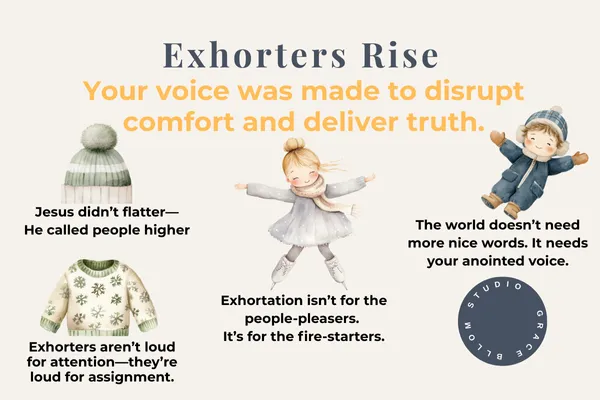
The Gift of Exhortation: How to Lead Like Jesus with Boldness, Love, and Truth
The gift of exhortation isn’t just about giving “feel-good” pep talks or dropping encouraging one-liners on Instagram. Oh no—this is a Kingdom weapon placed in the hands of bold, Spirit-led believers who aren’t afraid to call people UP into truth, alignment, and Kingdom identity.
Exhortation is fierce. It’s faithful. And it’s Holy Spirit fire in word form.
Jesus Himself modeled this gift to perfection—loving radically, correcting boldly, and standing unwavering in truth even when it wasn’t popular.
If you’ve ever felt like your voice is “too much,” too direct, or “too bold” for modern church culture…
You just might be an exhorter.
In this post, we’re breaking down what the gift of exhortation really is, how Jesus modelled it, and why the Church desperately needs this gift operating in full force right now. Get ready to activate your voice, your conviction, and your call.
What is the Gift of Exhortation?
In the Kingdom, exhortation isn't just about cheering people on. It's a spiritual gift rooted in divine empowerment to strengthen, encourage, and challenge others into alignment with God's truth—even when it's uncomfortable. And guess what?
Jesus was the ultimate Exhorter.
If you carry this gift, it’s time to rise. Let’s look at how Yeshua (Jesus) walked it out and how we can follow His bold, radical example.
Yeshua the Exhorter: Loving When It’s Hard
Jesus didn’t just preach love—He lived it in the most radical, challenging, countercultural way. He called people UP, not just out.
Luke 6:27-35 (AMP) - Radical Love in Action
“But I say to you who are listening now to Me: love your enemies, do good to those who hate you, bless those who curse you, pray for those who abuse you...”
Let’s pause right there. That’s not soft love—that’s warrior love.
This entire passage from Luke 6:27-35 shows Jesus exhorting us to:
Love our enemies
Bless those who curse us
Pray for those who mistreat us
Give generously without expecting anything in return
Be kind to the ungrateful and the wicked
Exhorters Aren’t People-Pleasers
True exhorters don’t flatter. They challenge with compassion, just like Jesus did.
“And as you would like and desire that men would do to you, do exactly so to them.” — Luke 6:31
He taught us to live above the world's standards, not just blend in.
“If you love those who love you, what credit is that to you? Even sinners do that.” — Luke 6:32
He was clear: Kingdom love requires Kingdom boldness. Exhorters aren’t afraid to love people through correction and discomfort because they know truth is the most loving thing of all.
The Cost of Exhortation
Matthew 19:21
“If you would be perfect, go, sell what you have and give to the poor, and you will have treasure in heaven; and come, follow Me.” — Matthew 19:21
Exhortation isn’t about being liked—it’s about calling people into obedience and deeper intimacy with the Father.
Jesus lovingly challenged the rich young ruler with a hard truth. That’s what exhorters do: we call people to surrender, even when it costs them something.
You can’t walk in the anointing and coddle people at the same time.
Exhorters Stand for Truth
John 18:37
“For this I was born, and for this I have come into the world—to bear witness to the truth. Everyone who is of the truth hears and listens to My voice.” — John 18:37
Jesus came to bear witness to the Truth, and as exhorters, we do the same.
We don’t water it down.
We don’t shrink to make people comfortable.
We speak boldly, rooted in love and led by the Spirit.
If you’ve been called to exhort, you’ve been called to be a voice of clarity in a world of confusion. That means truth might offend—but it also transforms.
Exhortation in the Torah: How God Built Courage in Leaders
Exhortation isn’t just a New Testament idea—it’s been a core part of God’s Kingdom blueprint since the Torah. In this post, we’ll explore how exhortation shows up in the Old Testament (Torah) and how God used this gift to raise up bold, courageous leaders who would lead His people into promise.
Let’s dive in.
Moses Exhorts Joshua: Courage to Lead
God commanded Moses to encourage and strengthen Joshua, one of the two faithful spies, because Joshua would lead Israel into the Promised Land.
“But Joshua son of Nun, who stands before you, he shall enter there. Encourage him, for he shall cause Israel to inherit it.”
— Deuteronomy 1:38
“But charge Joshua, and encourage and strengthen him, for he shall go over before this people and he shall cause them to possess the land which you shall see.”
— Deuteronomy 3:28
Joshua didn’t need more skill. He needed courage—and God used exhortation to build that boldness in him.
Hezekiah: Encouraging a Nation Back to God
King Hezekiah restored temple worship in Israel and exhorted the priests to get back in position.
“He appointed the priests to their positions and encouraged them in the service of the house of the Lord.”
— 2 Chronicles 35:2
Leadership means calling people back to purpose. That’s exhortation in action.
Everyday Encouragement in Community
God's Word shows us that exhortation wasn’t just for prophets and kings—it was for everyone.
“They help everyone his neighbor and say to his brother, ‘Be of good courage!’”
— Isaiah 41:6
“The carpenter encourages the goldsmith, and he who smooths with the hammer encourages him who strikes the anvil...”
— Isaiah 41:7
Exhortation builds community. It fuels purpose. It calls people higher.
Strength for Battle: Encouraging the Warriors
“But the people, the men of Israel, took courage and strengthened themselves and again set their battle line...”
— Judges 20:22
Sometimes we have to encourage ourselves to step back into the fight. That's Kingdom grit.
Raising Up the Next Generation of Exhorters
Young men preparing for leadership were taught how to exhort with truth, sound doctrine, and spiritual maturity.
“He must hold fast to the sure and trustworthy Word of God… so that he may be able to give stimulating instruction and encouragement…”
— Titus 1:9
“Urge the younger men to be self-restrained… show yourself in all respects to be a model of good deeds.”
— Titus 2:6-7
Don’t just talk truth—live it out so the next generation has an example to follow.
What is a True Exhorter?
A true exhorter comforts, challenges, and consoles.
(a) To Comfort
“Walking in the reverential fear of the Lord and in the consolation and exhortation of the Holy Spirit...”
— Acts 9:31
(b) To Exhort
“He who exhorts, let him give himself to his exhortation…”
— Romans 12:8
“Till I come, devote yourself to… exhortation and teaching.”
— 1 Timothy 4:13
(c) To Console
“So through Christ comfort is also shared and experienced abundantly by us…”
— 2 Corinthians 1:5-7
A balanced exhorter does all three. If you’re only encouraging without calling people higher, you’re comforting people into stagnation. And we don’t do lukewarm over her.
Three Marks of a True Exhorter: How to Lead with Purity, Power & Purpose
The Bible doesn’t just describe what an exhorter is called to do—it warns us about what an exhorter must avoid. That’s right—before we start encouraging others, the Word tells us to check our motive, our message, and our method.
1. An Exhorter Must Be Without Deceit
“For our appeal does not originate from delusion or error or impure purpose or motive, nor in fraud or deceit.”
— 1 Thessalonians 2:3
That means NO:
Delusion (2 Timothy 2:3)
Deception (Ephesians 4:14)
Doctrinal error (Romans 1:27, Jude 11, James 5:20)
Fraudulence, manipulation, or false teaching
Bottom line: You can’t lead people out of bondage if you’re bound by your own ego or agenda. Exhorters must be grounded in truth and clean in heart. No gimmicks. No games.
2. An Exhorter Must Be Pure in Motive
“So then, brethren, we are debtors, but not to the flesh… For if you live according to the flesh, you will die.”
— Romans 8:12-13
Godly exhortation doesn’t stir up carnal desires—it kills them.
A true exhorter doesn't feed people's flesh for applause. She feeds their spirit for transformation. That’s the Kingdom difference.
Exhorters must walk in:
Self-control
Purity of heart
Submission to the Spirit over feelings or flattery
3. An Exhorter Must Be Without Guile (Deception or Craftiness)
“Full of envy and jealousy, murder, strife, deceit and treachery...”
— Romans 1:29
“No lie was found upon their lips, for they are blameless before the throne of God.”
— Revelation 14:5
Guile = hidden motives, manipulation, spiritual baiting.
True exhorters don't trick people into righteousness—they call them up in truth and love.
Jesus was never sneaky with His words. He spoke plainly, boldly, and with divine clarity. That’s your model.
The Kingdom Purpose of the Exhorter
“A word fitly spoken is like apples of gold in settings of silver.”
— Proverbs 25:11
Let’s talk about how this gift actually plays out in your life:
Practical Signs of an Exhorter:
You break things down into “how-to” steps, not just theories
You call out potential and challenge people to rise higher
You share what works based on experience—then validate it with the Word
You don’t just talk the talk—you walk in what you believe
You love people where they are but don’t leave them there
You live your faith practically, not just theologically
“Better is a neighbor who is near [in spirit] than a brother who is far off [in heart].”
— Proverbs 27:10
How to Grow in This Gift
Study the Word daily – You can’t lead people to Truth if you don’t know it.
Pray for purity of heart – Ask the Lord to refine your motives.
Practice loving correction – Speak truth with grace.
Be consistent in private and public – Your walk matters more than your words.
Stay submitted to wise counsel – Even exhorters need exhortation.
Exhorters Don’t Just Speak—They SHIFT Atmospheres
If you’ve felt that fire in your bones to speak truth, challenge mediocrity, and call people UP—you’re probably an exhorter!
But remember: this gift must be carried with humility, clarity, and boldness rooted in the Word.
📖 Scripture Recap for Study:
1 Thessalonians 2:3 – No deceit, impure motive, or fraud
Romans 8:12-13 – Live by the Spirit, not by the flesh
Romans 1:29 – Deceit is a mark of unrighteousness
Revelation 14:5 – No lies in the mouths of the blameless
Proverbs 25:11 – A word in season is like apples of gold
Proverbs 27:10 – Proximity matters more than relation
How to Identify the Gift of Exhortation: 7 Signs You Might Be an Exhorter
Do you often find yourself encouraging others, helping them push past limitations, or being the go-to friend for advice and hope-filled truth?
You might just carry the spiritual gift of exhortation—and it’s time to own it like the Kingdom leader you are.
Here’s how to recognize the mark of an exhorter, both in yourself and in others.
What is an Exhorter?
An exhorter is someone gifted by God to encourage, uplift, and activate others in truth and purpose. But this isn’t just about hype or nice words—true exhorters call people higher with wisdom, love, and boldness.
Let’s break down the practical traits of someone operating in the gift of exhortation…
They’re Deeply Relational and People-Focused
“A man who has friends must himself be friendly...”
— Proverbs 18:24
Exhorters thrive in community. They are often:
Outgoing and magnetic
Always down for a gathering or connection point
Motivated by relationship more than rules
They build bridges, not walls—sometimes even at the cost of their own comfort.
They Can Talk to Anyone
Exhorters can turn a stranger into a friend in five minutes flat
They:
Easily spark conversation
Use humor and warmth to disarm others
Make people feel seen and accepted right away
If you’re the one who ends up talking to the cashier for 10 minutes and praying for her by the end—you just might be an exhorter.
They’re Bold Communicators (Even Loud Ones)
“Let your conversation always be full of grace, seasoned with salt…”
— Colossians 4:6
Exhorters aren’t afraid of passionate discussions. In fact:
They like debate when it’s productive
They express themselves freely and directly
They’ll challenge you lovingly but firmly
They bring truth AND energy. You’ll feel it when they walk in the room.
They Are Quick to Pivot and Embrace New Ideas
Exhorters love possibility thinking. They’re:
Unafraid of change
Fast to see opportunity
Willing to shift gears when needed
Sometimes they can move too quickly—abandoning old ideas before they’ve been fully tested. That’s why they thrive with wise accountability.
They Often Seek Consensus…Then Lead Boldly
Exhorters are relational, so they:
Like to understand how others feel
Sometimes “poll the room” to gauge direction
Can aggressively pursue the group’s chosen idea (even without full understanding)
⚠️ Caution: Exhorters must stay grounded in the Word, not just in what’s popular. Discernment is key here.
They Love Personal Coaching—but Need to See Growth
Exhorters are amazing one-on-one encouragers. They:
Want to help people heal and grow
Invest emotionally in others
Can walk away if they don’t see change (because their time is valuable)
Their gift isn’t just words—it’s transformation. If someone isn’t open to that, the exhorter will feel the need to shift their focus.
They Desire Reconciliation—Even if It Means Taking the Blame
“Blessed are the peacemakers, for they shall be called sons of God.”
— Matthew 5:9
Exhorters value peace in relationships. They:
Want to clear the air quickly
Will own fault just to restore the connection
Pursue unity over pride
This heart for reconciliation makes them powerful tools for healing and unity in the Body of Christ.
The Self-Image of the Exhorter: Strengths, Struggles, and the Spirit's Refining Fire
The gift of exhortation is a powerful weapon in the Kingdom, but it must be wielded with humility, self-awareness, and submission to the Holy Spirit.
Let’s be real—exhorters can light up a room, but without discipline, that same fire can burn bridges. So how do we steward this gift with integrity?
Let’s dive into the true self-image of the exhorter, the struggles they face, and how to grow into maturity through truth.
The Exhorter’s Default Self-Image: “I’m Fine!”
Exhorters usually carry a strong, positive self-image. Their relational skills and outgoing nature help them:
Stay upbeat (even if it's a mask 😬)
Deflect personal problems onto others
Keep the peace—sometimes through compromise, not conviction
But under the surface, if they’re not careful, they may:
Struggle with rebellion toward authority
Resist correction and think they can “talk their way out”
Throw verbal tantrums when they don’t get their way
The gift is real—but the sanctification is necessary.
Critical Success Factors for the Exhorter
1. Regularly Seek God’s Word—Not Just People’s Praise
“With his mouth the godless man destroys his neighbor, but through knowledge the righteous are delivered.”
— Proverbs 11:9
The Exhorter opens hearts with words—but what are you putting in those hearts?
You must go to God daily for truth, or you risk speaking man's wisdom instead of Heaven's.
2. Don’t Let “Good Intentions” Lead People Astray
Your charisma isn’t a substitute for God’s voice.
“He who flatters his neighbor spreads a net for his own feet.”
— Proverbs 29:5
Without intentional restraint, Exhorters can:
Talk too much and wound others with unnecessary words
Overexplain what God told them instead of simply obeying
Let emotions override discernment
Learn to say what God says—and stop where He stops.
3. Surround Yourself With Strong, Godly Leadership
Don’t build a fan club—build accountability.
Exhorters must be careful not to only surround themselves with people who “need” them. That can create:
Codependent dynamics
Manipulation masked as ministry
A false sense of superiority
Stay submitted. Stay sharpened. Stay teachable.
Watch Out for the Trap of Escapism
Exhorters can easily turn to comforts like:
Food, wine, or people-pleasing
Over-socializing as a way to avoid personal pain
Hospitality used to distract from healing
They may present a polished image to others while hiding from truth inside themselves.
But —God isn’t fooled by your mask.
Domain of Personal Warfare: Denial & Hypocrisy
“He who talks too freely reveals secrets… do not associate with him.”
— Proverbs 20:19
The Exhorter must make war against:
Spiritual manipulation
Using charm to avoid accountability
Blaming others for their own shortcomings
Pretending to care but offering no true effort
This gift cannot be used to escape reality or deny sin.
The Exhorter Must Proclaim…
“I will take responsibility for my actions.”
“I will face the pain I’ve caused instead of avoiding it.”
“I will invest in my own growth before trying to fix others.”
“I will not use flattery, excuses, or smooth words to manipulate.”
“I will not wear holiness as a mask. I will live it out in truth.”
That’s Kingdom maturity.
Sign of the Holy Spirit: The Wind of God
“The Spirit of God was moving (hovering, brooding) over the face of the waters.”
— Genesis 1:2
The wind of God—the gentle yet powerful presence of the Holy Spirit—reflects the exhorter’s role. You hover, guide, stir, and speak life into chaos.
But only when your spirit is surrendered.
📖 Scripture Recap:
Proverbs 11:9-13 – Words can destroy or deliver
Proverbs 16:28 / 20:19 / 29:5 – Avoid gossip, flattery, and manipulation
Genesis 1:2 – The Spirit moved with purpose, not performance
Proverbs 25:11 – Speak what is timely and true
The Attacks Against the Exhorter: How to Protect Your Gift from Destruction
You carry the gift of exhortation—that means you’re wired to uplift, mobilize, and activate people into their purpose. But let me be clear, sis: your gift is a threat to hell, and the enemy WILL try to shut it down, twist it, or trap it.
Let’s expose the attacks that come against Exhorters—so you can walk in freedom, not frustration.
1️⃣ Parental Influence: When Foundation is Faulty
Your upbringing can either strengthen your gift—or leave it open to distortion. The role of a father or spiritual parent is critical in shaping the identity of an Exhorter.
“Train up a child in the way he should go...”
— Proverbs 22:6
When this foundation is missing:
You may dominate conversations
Interrupt others to insert your opinion
Use Scripture out of context to make your point
Exaggerate stories to be more “interesting”
Oof 😬 That hits. But it’s real.
If you weren’t taught how to handle truth with honor and humility, you might be wielding your gift with more charisma than character. God will often pull Exhorters into isolation to refine them—just like He did with Moses, Paul, and Jeremiah.
If you’ve never had a wilderness season, don’t rush the mic. Let the Lord break and build you first.
2️⃣ Woundedness from Authority: When Rejection Breeds Control
“For rebellion is as the sin of witchcraft…”
— 1 Samuel 15:23
Because Exhorters are friendly and upbeat, many assume they aren’t wounded. But when they experience rejection—especially from authority figures—it can go deep. Real deep.
If not healed, that wound can:
Lead to vows like “I’ll never be under authority again”
Manifest as a Jezebel spirit (manipulation, control, spiritual seduction)
Shift the Exhorter from truth-teller to people-pleaser or platform climber
In group settings, wounded Exhorters can burn everyone with broad judgment, instead of lovingly confronting individuals.
World changers who don’t walk in holiness wound the Body of Christ.
3️⃣ Generational and Spiritual Warfare: When the Gift is Rejected
“He will bless those who fear the Lord, both great and small.”
— Psalm 115:13
Sometimes, the gift of exhortation has been rejected, suppressed, or even abused in past generations. And here’s the truth:
If a gift is rejected in one generation, it can manifest in perversion or rebellion in the next.
This can show up as:
Denial
Manipulation
Emotional immaturity
Refusal to take responsibility
This is spiritual and generational. But you are the curse breaker. Speak life over your gift and walk in full restoration.
Root Stronghold: Denial
The biggest internal battle for the Exhorter? Denial.
It’s easier to:
Avoid personal accountability
Shift the blame
Present a polished “I’m fine” mask instead of dealing with heart issues
But … there’s no healing in hiding. You can’t encourage others to face truth if you’re running from your own. The gift will only bear fruit when it’s anchored in authenticity, not performance.
How to Overcome These Attacks
Here’s your Kingdom action plan:
1. Embrace the Wilderness
Don’t fight the season of pruning. Let God refine you in the secret place before He releases you in the public one.
2. Submit to Authority
Choose to walk under God-ordained leadership. You can’t lead well if you refuse to be led.
3. Repent for Generational Patterns
Break agreements with pride, manipulation, and denial. Plead the blood of Jesus and declare healing over your family line.
4. Speak Life—With Accuracy
Ask the Holy Spirit to guide your words. Speak what He says, nothing more, nothing less.
📖 Scripture Power for Healing & Protection
Proverbs 22:6 – A child trained in truth stays rooted
1 Samuel 15:23 – Rebellion is like witchcraft
Psalm 115:13 – Generational blessing is available
Genesis 1:2 – The Spirit hovers to bring life from chaos
Proverbs 29:5 – Flattery is a trap, not favor
Final Word: Exhorter, Stay on the Altar
You are called to raise the standard. To call people higher. To exhort with fire and faithfulness.
But your gift is too powerful to play with.
Refuse to be another loud voice with no integrity behind it.
“God is not mocked; a man reaps what he sows.”
— Galatians 6:7
Stop avoiding the wilderness.
Start embracing the fire of refinement.
And walk boldly in truth—no filters, no fluff.
Want to Equip the Next Generation of Kingdom Warriors?
If this post stirred your spirit —don’t stop here.
You can raise exhorters-in-training with these powerful, printable tools designed for spirit-filled families.
👇 Check out these anointed resources for kids (ages 5–10):
🏝️ Island Boundaries
A beautifully illustrated workbook that teaches kids how to set God-honoring boundaries with wisdom, courage, and love.
✔️ 15 Bible-based lessons
✔️ Drawing, journaling & memory verses
✔️ Parent guide + certificate of completion
📚 Great for homeschool or devotionals!
🦁 Brave Hearts Who Choose Light
This is more than a workbook—it’s a spiritual weapon!
✔️ 18 lessons on Esther, David, Daniel & Paul
✔️ Spiritual courage, discernment, and faith challenges
✔️ Prophetic declarations + creative activities
🌙 Little Dreamers
A gentle guide to help kids hear from God at night and journal their dreams.
✔️ Guided dream journal (Ages 6–10)
✔️ Spirit-filled prayers & visuals
✔️ Single mom notes included 💖
🕊 Kids Who Worry
Help your child walk through anxiety and fear with Jesus-centered calm.
✔️ 20+ printable pages for emotional + spiritual support
✔️ Journaling, prayer, scripture, and peace declarations
👂 Little Prophets
Train your child to hear God’s voice and walk boldly in their prophetic gift.
✔️ 20+ printable pages (ages 5–10)
✔️ Games, journaling, and Spirit-led activities
✔️ Parent teaching guide included!
📥 Grab the full printable bundle here
Let’s raise bold, prophetic, boundary-strong Kingdom kids together. 💪👑
